

Workplaces are changing fast. Not long ago, being a manager meant showing up in person, walking around the office, and keeping an eye on what people were doing. Productivity was measured by how busy everyone looked. That approach worked for years, but it doesn’t fit anymore.
Cut to 2026: teams are spread out across cities and time zones. Work happens through complex digital tools, and people expect a healthier balance between their jobs and their lives. The old way of managing by physical presence isn’t just outdated, it’s impossible.
Enter the era of intelligent operations. Organizations are no longer asking if they should adopt automation; they are asking how quickly they can integrate AI productivity tools for teams to stay competitive. The transition from manual to AI-driven management is beyond a technical upgrade; it is a fundamental reimagining of how people, projects, and performance intersect.
Still Managing Teams Manually? It’s Time to Upgrade
The Hardships of Manual Team Management
Manual management relies heavily on human observation and subjective interpretation. In a small office, this might feel personal, but the flaws become glaring as soon as a team scales or moves to a remote model.
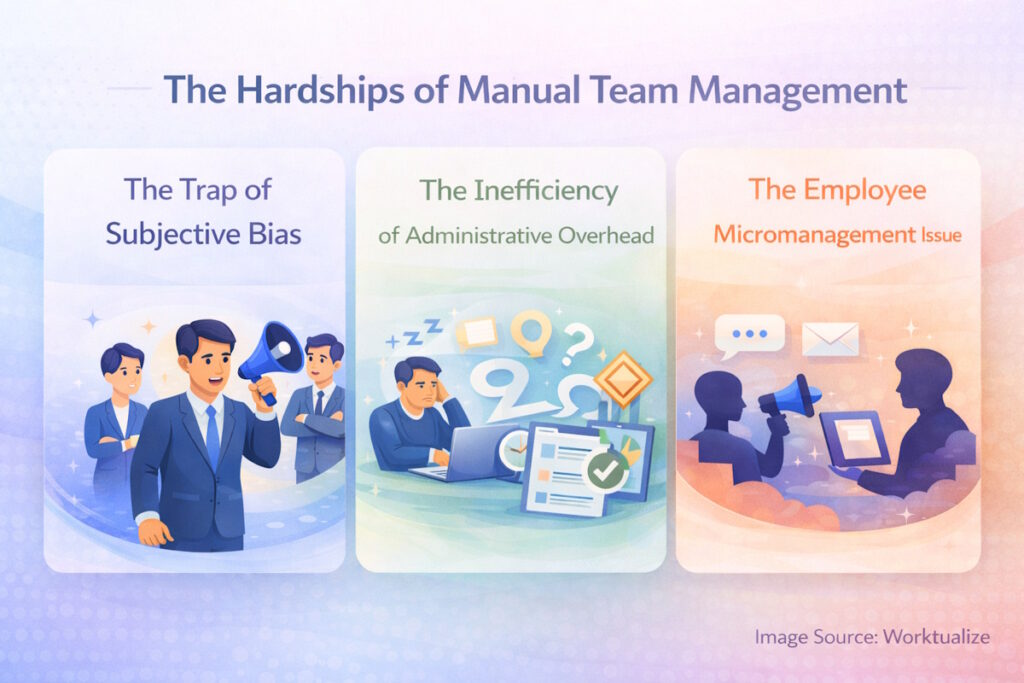
1. The Trap of Subjective Bias
When managers rely on manual check-ins, they often fall prey to proximity bias. They favor the employees they see the most or those who are the loudest about their achievements. This leaves quiet and high-performing contributors feeling overlooked.
It is evident that without objective data, performance reviews become a battle of opinions rather than a reflection of actual output. This lack of transparency breeds resentment and can lead to a toxic work environment where perceived busyness is valued over actual results.
2. The Inefficiency of Administrative Overhead
Think about the time a manager spends collecting weekly status reports, manually updating spreadsheets, and chasing down team members for updates. This administrative noise consumes hours that should be spent on strategy and coaching.
Additionally, manual time tracking software for employees often involves staff filling out timesheets at the end of the week based on memory, which is notoriously inaccurate. Studies show that manual time entry leads to significant leaks in billable hours and a general lack of accountability.
3. The Employee Micromanagement Issue
In an attempt to maintain control over remote or hybrid teams, many managers resort to excessive checking in. Frequent pings on chat apps or unscheduled video calls disrupt the deep work of employees. This creates a culture of productivity theater where staff focus on looking busy rather than being productive. It erodes trust and is the primary driver of employee burnout in the digital age. When a manager feels the need to manually verify every minute of an employee’s day, they are not managing; they are hovering.
How AI is Redefining Employee Productivity
The introduction of AI productivity tools for teams has flipped the script. Instead of managers hunting for information, AI brings the information to them in a structured, actionable format. This technology acts as a silent partner to handle the how of work so humans can focus on the why.
Intelligent Resource Allocation
One of the most complex tasks for any manager is knowing who is overworked and who has the capacity for more. Manual systems fail here because they cannot see the granular progress of tasks. AI software analyzes historical data and real-time activity to predict project timelines accurately.
Suppose, if a developer is bogged down by a specific bug, the AI identifies the bottleneck and suggests reallocating resources before a deadline is missed. This ensures that no single team member is carrying an unfair load, which is essential for long-term retention.
Removing the Need for Constant Check-ins
With remote team productivity tracking powered by AI, the need for messages asking if someone is there vanishes. AI tools can detect active versus idle time without being intrusive. They provide a high-level view of team momentum, which allows managers to see that work is progressing without needing to hover over an employee’s shoulder.
Such a situation creates a psychological safety net where employees feel trusted to manage their own schedules. It shifts the focus from hours logged to goals achieved.
Data-Driven Coaching
Instead of a vague statement that someone needs to work faster, AI provides specific insights. It can identify that a team member spends 40% of their day in meetings, leaving little room for deep focus. A manager can then use this data to cancel unnecessary meetings, directly improving the employee’s experience and the company’s bottom line.
Such a level of granular detail allows for personalized professional development plans that actually make a difference in an employee’s career trajectory.
The Evolution of Employee Monitoring
There is a significant difference between traditional employee monitoring software and modern AI-driven productivity intelligence. Early versions of monitoring software were often perceived as Big Brother tools that capture every keystroke or take random screenshots to catch people slacking.
In 2026, the focus has shifted from policing to empowering. Modern AI productivity tools for teams use behavioral analytics to establish baselines. They do not just watch what an employee does; they understand the context. For example, if an employee’s productivity dips on a Tuesday, an AI system might notice it correlates with a high volume of internal emails, suggesting a process issue rather than a performance problem.
As a result, such a nuanced understanding prevents unfair reprimands and helps leadership identify systemic hurdles that are slowing everyone down. Furthermore, remote team productivity tracking now serves the employee as much as the employer. Staff can access their own dashboards to see where their time goes, helping them self-correct and improve their personal efficiency. It turns the data into a mirror rather than a weapon, fostering a culture of self-improvement and high performance.
Want Real-Time Visibility Without Micromanagement?
Bridging the Gap Between In-House and Remote Team Management
The hybrid model is the new reality. Managing a team where half the members are in the office and the rest across the globe is a logistical nightmare for a manual manager. Without a unified digital layer, information silos form quickly. Remote workers often feel disconnected or undervalued compared to their in-office counterparts.
AI software acts as the connective tissue for these split teams. Using advanced time tracking software for employees, organizations can ensure that every hour worked is accounted for, regardless of location. These tools provide a single source of truth for project progress. When everyone (from the CEO to the intern) can see the same real-time data, the friction of distance disappears. Such a leveling of the playing field ensures that career advancement is based on merit and output rather than who happened to be standing by the coffee machine when a senior executive walked by.
Moreover, the best employee monitoring tools today incorporates sentiment analysis. It can gauge the morale of a remote team by analyzing communication patterns. If the AI detects a sharp increase in negative sentiment or a decrease in collaboration, it can alert a manager to check in on the team’s mental well-being. This proactive approach to mental health is something manual management simply cannot replicate at scale.
The Cost of Manual Team Management
Organizations that cling to manual processes are paying a hidden tax. This tax manifests in high turnover rates, missed deadlines, and poor work quality. When a manager is buried in administrative tasks, they lose the ability to lead. They become a bottleneck in the workflow, delaying decisions because they are waiting for a manual report that is already outdated by the time it arrives.
In contrast, companies utilizing AI productivity tools for teams are more agile. They can pivot faster in response to market changes because they have a clear, real-time view of their operational capacity. They save thousands of dollars every month by eliminating the need for manual data entry and correction. Most importantly, they protect their most valuable asset: their people. Overall, they remove the need for micromanagement to create a high-trust environment that attracts top-tier talent.
Worktualize is Breakthrough of Team Management Automation and Intelligence
While many tools offer bits and pieces of the productivity puzzle, Worktualize has emerged as a comprehensive, AI-powered solution that has truly revolutionized team management. It is designed for the modern enterprise that demands high performance without the toxic side effects of micromanagement.
Worktualize provides a holistic view of the workforce to merge employee monitoring software with advanced analytics to drive growth.
Why Worktualize Stands Out
Worktualize is more than just a time tracking tool; it is a productivity partner. It bridges the gap between management oversight and employee autonomy through several key features:
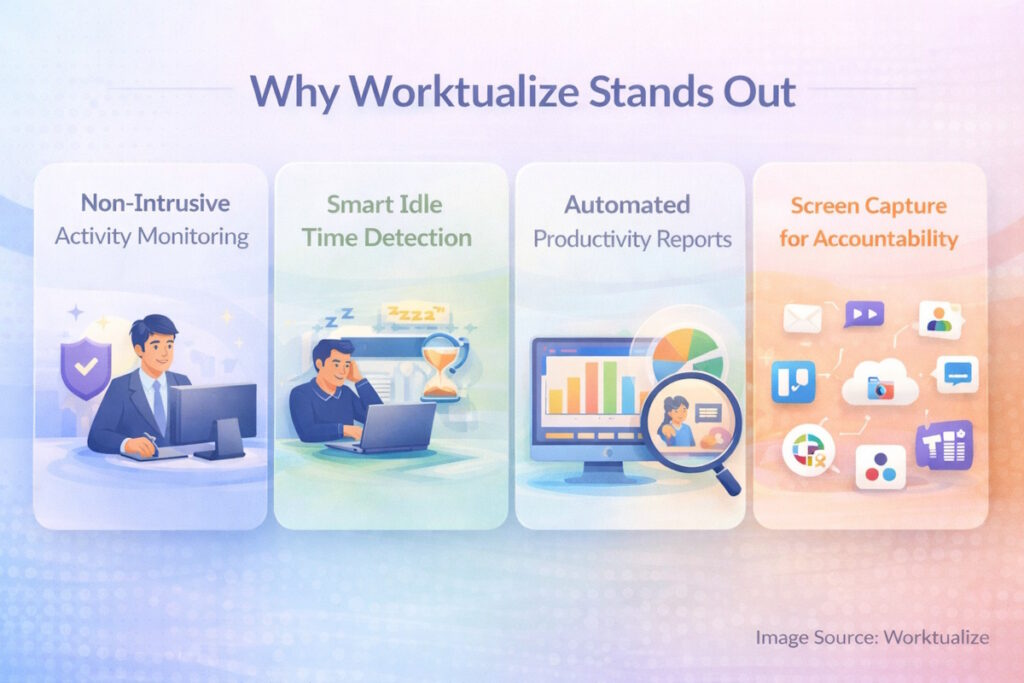
- Non-Intrusive Activity Monitoring: It tracks keyboard and mouse activity levels to provide a clear picture of engagement without invading privacy. This allows managers to see momentum rather than just presence. It respects the boundaries of the digital workspace while providing the necessary data for operational excellence.
- Smart Idle Time Detection: Worktualize identifies when an employee is away from their desk or inactive. This data is used to help teams understand their natural work rhythms and optimize their schedules for peak energy periods. It is about working smarter, not just longer.
- Automated Productivity Reports: Say goodbye to manual spreadsheets. Worktualize generates detailed, hour-wise reports on daily activities. This gives managers the data they need for 90% more accurate decision-making. These reports are ready at the click of a button, freeing up hours every week.
- Screen Capture for Accountability: For sensitive projects or remote onboarding, periodic screenshots provide a proactive safety net. This ensures that in-house and remote candidates stay aligned with project goals from day one. It provides a visual record of progress that can be invaluable for training and quality assurance.
- Comprehensive Integration: Worktualize acts as the premier time tracking software for employees, integrating with project management suites and communication tools to provide a seamless experience.
Remarkable Growth Without Micromanagement
Enterprises that have integrated Worktualize into their workflow report a staggering increase in output. Using this AI productivity tool for teams, managers can move away from the command-and-control style; instead, they become facilitators who clear paths for their team to succeed.
Also, one of the most significant benefits reported by Worktualize users is the 30% reduction in idle time. This is not achieved by cracking a whip; it is achieved through transparency. When employees see their own performance metrics, they are naturally motivated to improve.
Furthermore, HR departments have found that the automated time tracking software for employees within Worktualize has eliminated payroll discrepancies, leading to a much higher level of trust within the organization. Employees feel safe knowing their hard work is being accurately recorded and rewarded.
Seamless Integration for Global Success
Whether you are managing a small boutique agency or a large-scale enterprise with thousands of employees, Worktualize scales with you. It requires no complex hardware and integrates seamlessly into existing tech stacks.
For organizations looking to move away from the manual mess, Worktualize provides the clarity and precision needed to thrive in the AI era. It turns remote team productivity tracking from a challenge into a competitive advantage.
Companies using Worktualize have seen a marked improvement in employee satisfaction. Because the software handles the tracking, managers can spend their time on meaningful interactions, mentoring, problem-solving, and celebrating wins. This shift in focus is what leads to remarkable growth. When employees feel supported by data rather than scrutinized by a person, their creative and professional output reaches new heights.
The Cultural Impact of AI Management
Implementing AI productivity tools for teams does more than just boost numbers; it changes the culture of the company. It moves the organization toward a culture of results. In a manual environment, the person who stays until 8 PM is often viewed as the hardest worker. In an AI-driven environment, the data might show that the person who leaves at 5 PM is actually 20% more productive because they manage their time better.
This data-driven culture promotes fairness. It removes the unconscious biases that favor certain personality types over others. It ensures that the quiet engineer who solves complex problems in half the time gets the same recognition as the vocal project manager. Companies can use employee monitoring software that focuses on output and efficiency to build truly diverse and high-performing teams where everyone has an equal opportunity to succeed based on their actual contributions.
Future-Proofing Team Management for Your Organization
The world is not going back to the way it was. The flexibility of remote work is here to stay, and the complexity of digital tasks will only increase. Organizations that refuse to adapt will find themselves left behind, and they will be unable to attract talent or keep up with the efficiency of their competitors.
Investing in remote team productivity tracking and time tracking software for employees that leverages artificial intelligence is an investment in the future of your business. It provides the foundation for a resilient, agile, and high-performing workforce. It allows you to expand your talent pool globally, knowing that you have the tools to manage and support people regardless of their time zone.
Worktualize to Enhance Team Management and Productivity
The transition from manual to AI-enhanced management is more than a luxury; it is a survival strategy. The flaws of the manual past, such as bias, inefficiency, and micromanagement, have no place in a world that moves at the speed of light.
Embracing AI productivity tools for teams, you monitor your staff as well as give them the structure and the freedom they need to do their best work. Tools like Worktualize prove that visibility and trust can coexist, leading to unprecedented growth and a more engaged workforce.
The era of the stopwatch and the manual log is over; with Worktualize, the era of the intelligent, empowered, and high-growth team has begun.
Hence, the question is no longer whether AI will change your team management; rather, it is: are you ready to stop managing manually and start leading intelligently with the power of Worktualize?
Summarizing Table
| Feature | Manual Team Management | AI-Powered Management (Worktualize) |
| Data Collection | Relies on manual timesheets and verbal updates; prone to human error and forgetfulness. | Automated time tracking software for employees captures real-time activity and idle periods. |
| Managerial Style | Often leads to micromanagement due to a lack of visibility into remote workflows. | Fosters autonomy by providing high-level productivity trends without constant check-ins. |
| Objectivity | Performance reviews are often influenced by proximity bias or by who is the loudest. | Evaluations are based on objective data, keyboard/mouse activity, and actual task completion. |
| Administrative Load | Managers spend hours compiling reports, chasing updates, and correcting payroll. | AI productivity tools for teams generate instant, hour-wise reports for 90% more accurate decisions. |
| Remote Flexibility | Difficult to maintain culture and oversight; remote workers often feel disconnected. | Seamless remote team productivity tracking bridges the gap between in-house and global talent. |
| Productivity Focus | Focuses on hours at the desk or looking busy (productivity theater). | Focuses on momentum and output, identifying bottlenecks before they cause delays. |
| Trust Levels | Low trust environment; employees feel scrutinized by subjective observations. | High trust environment; transparency allows employees to self-manage and improve. |
| Operational Growth | Stagnant or slow growth due to manual bottlenecks and administrative friction. | Remarkable growth driven by a 30% reduction in idle time and better resource allocation. |