

The modern landscape of work is undergoing a seismic shift. We have moved from the traditional nine to five office model to a more fluid, decentralized, and digital first environment. In this new era, the primary challenge for businesses is no longer just about physical presence. It is about performance, transparency, and the efficient use of the most valuable resource we have, which is time.
Artificial Intelligence has emerged as the silent architect of this massive transformation. While much of the public conversation around AI focuses on generative tools or automated chatbots, one of its most profound impacts is happening within the systems we use to measure and manage our workdays.
Modern time tracking tools are infused with AI, and they are evolving from simple stopwatches into sophisticated performance intelligence platforms. This shift is not merely technological. It is a fundamental change in how we perceive productivity and labor.
Want to See How AI Can Improve Your Team’s Productivity?
The Evolution of Time Management
Historically, time tracking was a manual and often tedious process. Employees would log hours on paper or in spreadsheets at the end of the week, often relying on guesswork. This method was not only prone to error but also created a culture of surveillance where the focus was on hours clocked rather than value created. It led to frustration among high performers who felt their efficiency was being ignored in favor of those who simply sat at their desks for longer durations.
AI has flipped this script entirely. Today, smart time tracking software provides real-time visibility into how work happens. It eliminates the administrative burden of manual entry, allowing teams to focus on high-impact strategic work.
Automating the data collection process ensures 100 percent accuracy in attendance and payroll while offering deep insights into workflow patterns. This transition marks the end of the era of administrative overhead and the beginning of data-driven management.
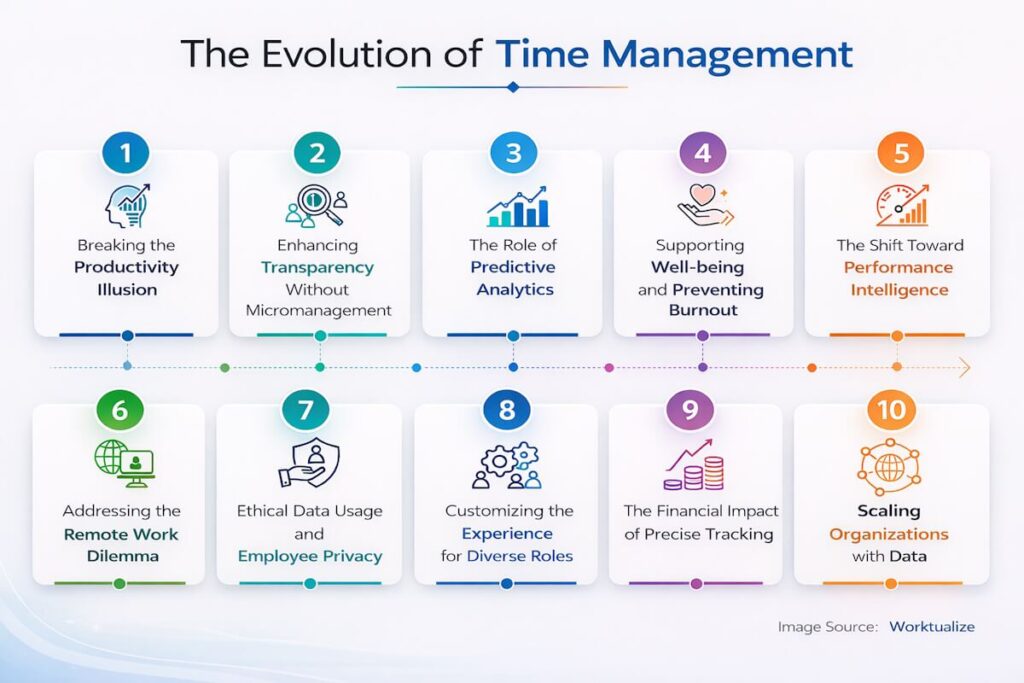
Breaking the Productivity Illusion
One of the most significant contributions of AI in the workplace is its ability to dismantle the productivity illusion. This is the phenomenon where employees appear busy, such as answering emails, attending meetings, and staying constantly active, yet the actual output remains low. In many corporate environments, busyness is often confused with effectiveness.
AI-driven tools solve this by differentiating between mere activity and genuine engagement. Monitoring mouse and keyboard activity alongside application usage allows these systems to identify when an employee is in a state of deep work versus when they are caught in a cycle of digital distractions. This data allows managers to identify patterns of focus and helps them redistribute workloads more effectively to prevent burnout.
Ultimately, it ensures that high-priority projects receive the attention they deserve. It provides a mirror to the organization, showing where energy is being spent and where it is being wasted.
Enhancing Transparency Without Micromanagement
A common fear among employees is that time tracking equals micromanagement. However, when implemented correctly, AI-powered tools actually do the opposite. They build trust through transparency. When both managers and team members have access to the same performance data, it fosters a culture of ownership.
Transparency removes ambiguity from the professional relationship. Employees can see their own progress, identify personal inefficiencies, and take charge of their own improvement journey.
When shared responsibly, data builds confidence rather than fear. It ensures that recognition is based on objective data rather than proximity or visibility. This is a crucial factor in remote and hybrid work environments where employees often worry about being invisible to leadership. Objective metrics provide a level playing field where work speaks for itself.
Struggling to Manage Productivity in Remote Teams?
The Role of Predictive Analytics
The future of work is not just about reporting what has already happened. It is about predicting what will happen next. AI-powered time tracking tools are now utilizing historical performance data to forecast potential delays or bottlenecks.
Analyzing past project data allows these systems to flag risks before they impact deadlines. If a specific task is taking longer than estimated based on previous cycles, the AI can alert managers to proactively adjust resources. This predictive capability is a game-changer for agile development with time tracking tools and complex project management, allowing teams to shift from reactive firefighting to proactive strategy. It gives leaders a crystal ball that helps them navigate project lifecycles with much higher precision.
Supporting Well-being and Preventing Burnout
In a world where the lines between home and office are blurred, burnout has become a major risk. AI helps mitigate this by monitoring work rhythms. Sudden spikes in idle time or consistently high active hours can signal that an employee is struggling or overextended.
Smart tracking systems encourage healthy habits by making these patterns visible. Leaders can intervene with support rather than suspicion, using insights to ensure balanced resource allocation. Instead of demanding more hours, the focus shifts to optimizing the hours already being worked, protecting the mental clarity and long-term productivity of the workforce. It turns a surveillance tool into a wellness tool that ensures the human element of the business is preserved.
The Shift Toward Performance Intelligence
We are moving away from the concept of time tracking and toward the concept of performance intelligence. Performance intelligence is the synthesis of time data, application usage, and project outcomes. It provides a holistic view of the health of an organization.
AI enables this by processing vast amounts of raw data into actionable reports. Managers no longer have to spend hours squinting at spreadsheets to understand why a project is behind schedule. The software does the heavy lifting, highlighting the exact areas where the workflow is stalled. This allows for a more surgical approach to management, where interventions are brief, effective, and data-backed.
Addressing the Remote Work Dilemma
Remote work has presented a unique challenge for traditional management styles. Without physical oversight, some managers feel a loss of control, while employees feel pressure to be constantly online to prove they are working. AI time tracking serves as a bridge that satisfies both parties.
Providing a clear log of activity gives the manager peace of mind that work is progressing. For the employee, it provides a clear record of their contributions, protecting them from unfair assumptions about their work ethic. It replaces the need for constant check-ins in meetings and status updates, freeing up more time for actual productivity. The tool becomes the evidence of work, allowing the employee to log off at the end of the day with the confidence that their output is documented.
Ethical Data Usage and Employee Privacy
As these tools become more powerful, the emphasis on ethics and privacy grows. Modern solutions offer granular controls, such as the ability to blur or disable screenshots and customize tracking parameters to suit specific roles. Ensuring that the business gets the data it needs to grow while the privacy and autonomy of the employee remain respected is a top priority for developers.
The best tools are those that prioritize the user experience. They should feel like an assistant rather than a spy. Features like manual start and stop buttons, private time settings, and transparent reporting dashboards ensure that the employee remains in control of their data. This balance is essential for maintaining morale and fostering a healthy corporate culture.
Customizing the Experience for Diverse Roles
Not every job is the same, and AI time tracking understands this. A software developer has different activity patterns than a graphic designer or a sales representative. AI can be trained to recognize these nuances.
Setting custom thresholds for idle time or specific application categories allows companies to tailor the tracking experience to the reality of the role. For example, a salesperson might spend a lot of time on calls or in meetings, which would look like idle time on a standard computer tracker. AI can integrate with calendars and communication tools to account for these activities, providing a true reflection of the workday.
The Financial Impact of Precise Tracking
Efficiency is not just about time. It is about the bottom line. Accurate time tracking is essential for precise billing and payroll. When every minute is accounted for, leakages are eliminated.
Automating these financial processes reduces the risk of human error and ensures that clients are billed fairly. It also helps companies understand the true cost of their services. If a project consistently consumes more hours than budgeted, the data will show exactly where the discrepancy lies, allowing for more accurate future pricing. This financial clarity is vital for the long term sustainability of any business, particularly in the service and tech industries.
Scaling Organizations with Data
Scaling a business requires a deep understanding of resource capacity. AI time tracking provides the data necessary to make informed hiring decisions. If the data shows that the current team is consistently at 90 percent capacity, it is a clear indicator that it is time to expand.
On the other hand, if productivity is low despite high hours, it might indicate a need for better training or improved internal processes. Having access to this level of detail allows for strategic scaling that is based on reality rather than intuition. It prevents the common pitfall of overhiring or underutilizing existing talent.
How Worktualize Bridges the Gap
Navigating this new frontier of work requires the right partner. Worktualize stands out as a premier solution in this space. It is more than just a time tracking software. It is a comprehensive performance intelligence platform designed to measure real business impact.
Worktualize combines precision tracking with actionable insights, helping organizations move from simple timekeeping to strategic growth. Simplifying the day for employees happens by automatically recording hours and providing a clear view of performance metrics. Offering a centralized dashboard for managers allows them to monitor project progress, assign tasks, and identify bottlenecks in real time.
The philosophy behind Worktualize is simple. Increasing visibility and efficiency should not involve resorting to frustrating micromanagement. Providing a shared, transparent view of work empowers teams to make decisions based on facts. This leads to several measurable benefits:
- Achieving a significant increase in overall productivity.
- Enhancing the reliability of on-time delivery for clients.
- Strengthening team spirit through fair and objective evaluation.
- Minimizing administrative tasks for HR and project managers.
Managing a remote software team, an offshore IT agency, or an in-house creative department becomes much easier when the software adapts to your specific workflow. Worktualize helps you track smarter and work better, ensuring that every minute counts toward your collective success. It creates a workspace where performance is recognized, efficiency is rewarded, and everyone is aligned toward the same goals.
Implementing a tool like Worktualize is an investment in the culture of your company. It signals to your team that you value their time and that you are committed to providing the resources they need to succeed. Moving toward a data-driven future does not mean losing the human touch. It means using technology to support and enhance human potential.