

It is no secret anymore that data is new fuel. Every department, from marketing to sales, relies on hard numbers to justify budgets and prove ROI. However, when it comes to software engineering, applying traditional factory-era metrics to a creative, cognitive process is a recipe for disaster.
For years, organizations have leaned on time tracking for developers as the primary gauge of success. The logic seems simple: if an engineer is at their desk for eight hours, they must be producing eight hours of value. But this logic is fundamentally flawed. Relying on hours logged as a proxy for developer productivity metrics is not just inaccurate; it is actively harmful to the health of your codebase and your culture.
To truly understand output, leadership must move away from the stopwatch and toward a more nuanced approach involving workforce analytics and sophisticated workforce intelligence platform tools.
Are you still measuring developer productivity by hours logged?
The Quantitative Approach in Software Engineering
The core issue with time tracking for developers is that it measures input rather than output. In a manufacturing plant, more hours on the line usually equate to more units produced. In software development, the relationship between time and value is often inverse. A senior developer might spend four hours staring at a screen, only to write ten lines of code that solve a complex architectural bottleneck. Conversely, a junior developer might log twelve hours writing 300 lines of redundant code that introduces three new bugs.
Who was more productive?
If you rely solely on developer productivity metrics based on time, the junior developer looks like a hero, while the senior developer looks like a slacker. This creates a dangerous incentive structure where volume and presence are rewarded over elegance and efficiency.
Why Hours Logged Fails as a Metric
Measuring the clock ignores the reality that software engineering is a cognitive, non-linear process where a single hour of deep focus can outweigh a week of distracted coding. This metric fails to account for code quality, architectural impact, or the technical debt created when developers prioritize speed over stability to satisfy time tracking for developers.
Ultimately, hours logged reward presence rather than performance. Hence, it obscures the true value delivered to the business through sophisticated employee productivity analytics.
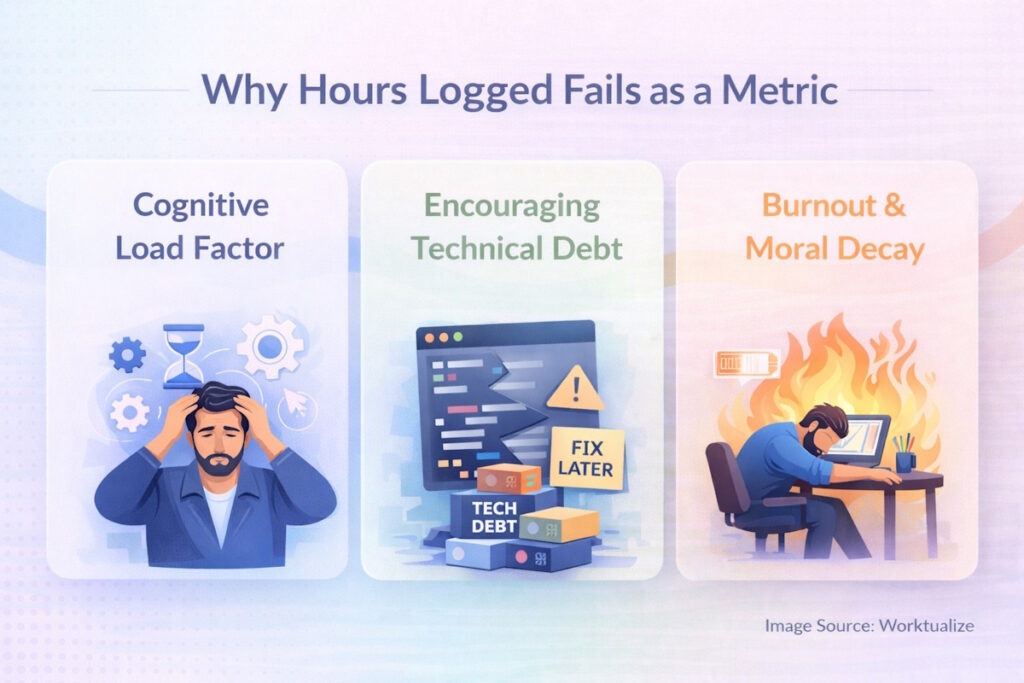
- The Cognitive Load Factor
Software development is deep work. It requires intense concentration and the ability to hold complex logical structures in one’s head. This state of flow is fragile. When developers are forced to use intrusive developer time tracking software that requires constant manual updates or task switching, their cognitive load increases. They spend less time solving problems and more time managing the perception of their productivity.
- Encouraging Technical Debt
When management focuses on hours and speed, developers are pressured to take shortcuts. If the goal is to show high activity within a workforce intelligence platform to prove they are working hard, they may skip writing unit tests, ignore documentation, or bypass peer reviews. This results in technical debt that will eventually slow the entire team down, and it will cost the company far more than the supposed hours saved.
- Burnout and Moral Decay
Micromanagement in form of time tracking is the fastest way to kill morale in a high-performing engineering team. Using time tracking for developers as a surveillance tool signals a lack of trust. When employees feel they are being watched like children, they lose their sense of autonomy and intrinsic motivation. Over time, this leads to burnout and high turnover rates, which are devastating to long-term developer productivity metrics.
The Shift Toward Employee Productivity Analytics
If hours are the wrong metric, what should leaders look at? The answer lies in employee productivity analytics that focus on outcomes, quality, and velocity rather than mere presence. Modern organizations are moving toward a more holistic view of performance.
| Old Metric | Modern Alternative | Why it Works |
| Hours Logged | Cycle Time | Measures how fast a feature goes from idea to production. |
| Lines of Code | Deployment Frequency | Focuses on the value delivered to the end-user. |
| Time at Desk | Change Failure Rate | Prioritizes quality and stability over raw speed. |
| Manual Check-ins | Workforce Intelligence Platform | Provides passive data without interrupting the flow. |
Utilizing a workforce intelligence platform, managers can see patterns that matter. For example, instead of seeing that a developer worked from 9 AM to 5 PM, they can see that the team experiences a bottleneck during the testing phase or that meetings are fragmenting the day so much that no one can achieve deep work.
Want better insights into your team’s real productivity?
The Role of Developer Time Tracking Software in Remote Work
With the rise of remote and hybrid work, the temptation to use developer time tracking software for surveillance has reached an all-time high. Companies are worried that if they cannot see their employees, they cannot know if they are working. However, the best workforce intelligence platform solutions are moving away from this Big Brother approach.
Instead of tracking every mouse movement, smart developer productivity metrics should focus on alignment…
- Is the work being done contributing to the sprint goals?
- Are the developers engaged?
- Are there signs of overwork that could lead to burnout?
When used correctly, employee productivity analytics serve as a diagnostic tool for the health of the organization, not a whip for the individual.
The Battle Between Quality and Quantity Every Time
In the world of bits and bytes, one great idea is worth a thousand mediocre ones. If your developer time tracking software shows that an engineer spent three hours researching a library rather than writing code, that is often a sign of high productivity. They are looking for the most efficient path forward rather than reinventing the wheel.
True developer productivity metrics must account for:
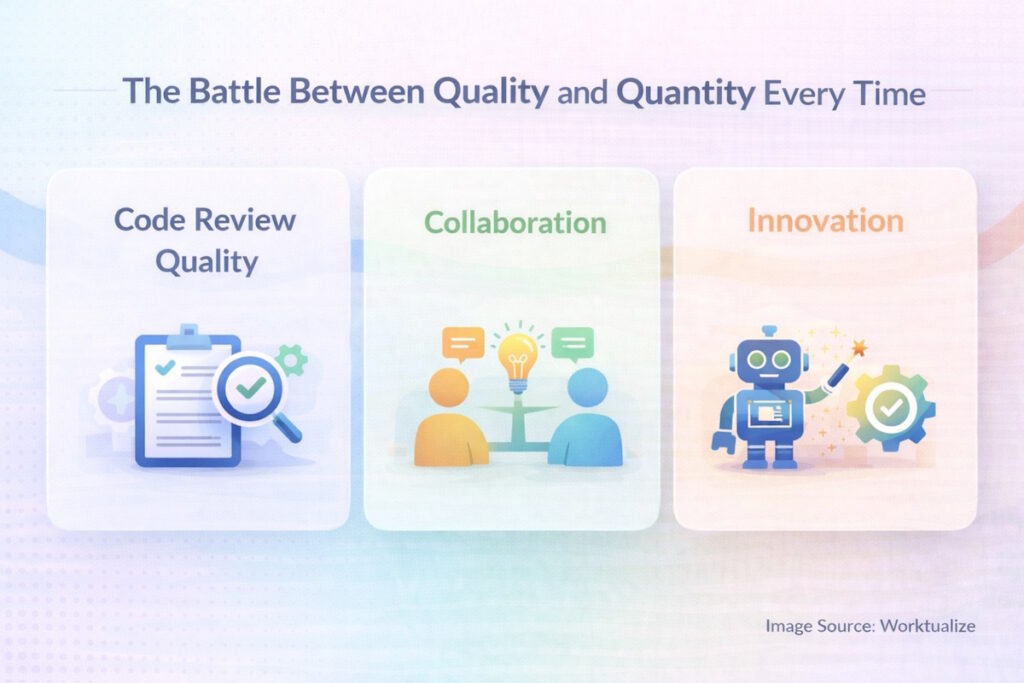
- Code Review Quality: Is the developer helping others improve?
- Collaboration: Are they contributing to a healthy team dynamic?
- Innovation: Are they finding ways to automate repetitive tasks?
These are the factors that drive business growth, yet they are completely invisible to a tool that only measures time tracking for developers.
The Impact on Workforce Intelligence
To lead a successful tech organization, you need more than just a spreadsheet of hours. You need a workforce intelligence platform that provides a 360-degree view of how work happens. This includes understanding the tools developers use, the hurdles they face, and the times of day they are most effective.
When you prioritize employee productivity analytics over simple time logs, you empower your team. You move from a culture of compliance to a culture of performance. You stop asking Where were you at 2 PM? and start asking How can I help you clear this roadblock?
Worktualize is Your Smart Path to Productivity
The challenge for most enterprises is finding a balance. You need to keep a check on your in-house and remote team productivity, but you do not want to become a micromanager. This is where Worktualize changes the game.
Worktualize is a smart productivity tracking tool designed with the modern developer in mind. Unlike traditional, intrusive developer time tracking software, Worktualize focuses on providing actionable insights without the friction. It is a comprehensive workforce intelligence platform that helps you understand how your team works without making them feel like they are under a microscope.
Why Worktualize is Different
When you shift your focus from hours logged to meaningful developer productivity metrics, you create an environment where engineers can do their best work. Stop measuring the clock and start measuring the impact.
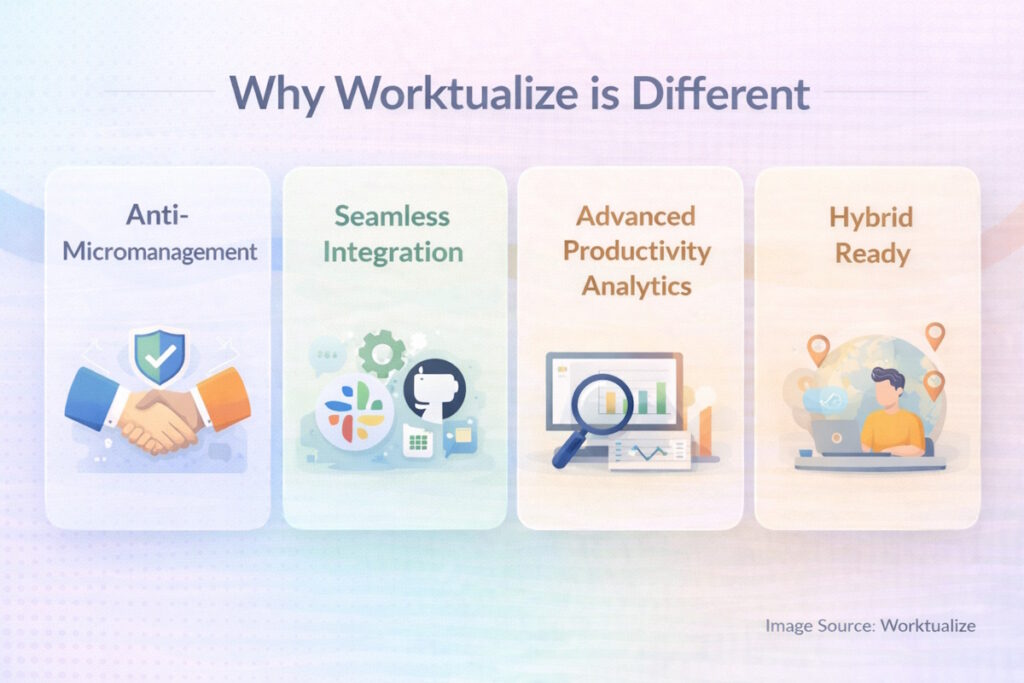
- Anti-Micromanagement: We believe in trust. Our tool provides the data you need to manage effectively without the intrusive surveillance that kills creativity.
- Seamless Integration: It is easy to use and fits perfectly into the existing workflow of your engineering team.
- Advanced Employee Productivity Analytics: Get deep insights into project progress and team health, allowing you to make data-driven decisions.
- Hybrid Ready: Whether your team is in the office or scattered across the globe, Worktualize is the best way for enterprises to maintain visibility and support their staff.
Rethinking the Future of Work
The era of clocking in and clocking out is over for knowledge workers. As software continues to eat the world, the companies that thrive will be those that treat their developers as creative problem solvers, not line workers.
Investing in a proper workforce intelligence platform like Worktualize allows you to capture the data necessary for business growth while respecting the autonomy of your talent. It provides the employee productivity analytics needed to scale, the developer time tracking software features that simplify administration, and the peace of mind that comes from knowing your team is aligned and thriving.
Stop making the mistake of equating time with value. Embrace a smarter way to track, support, and empower your workforce.